
Theatre Dunia - Vol. - 14, Issue - 1, May 2026
₹ 600 / Piece
₹ 750
20%
₹ 630 / Piece
Inclusive of Tax

Highlights
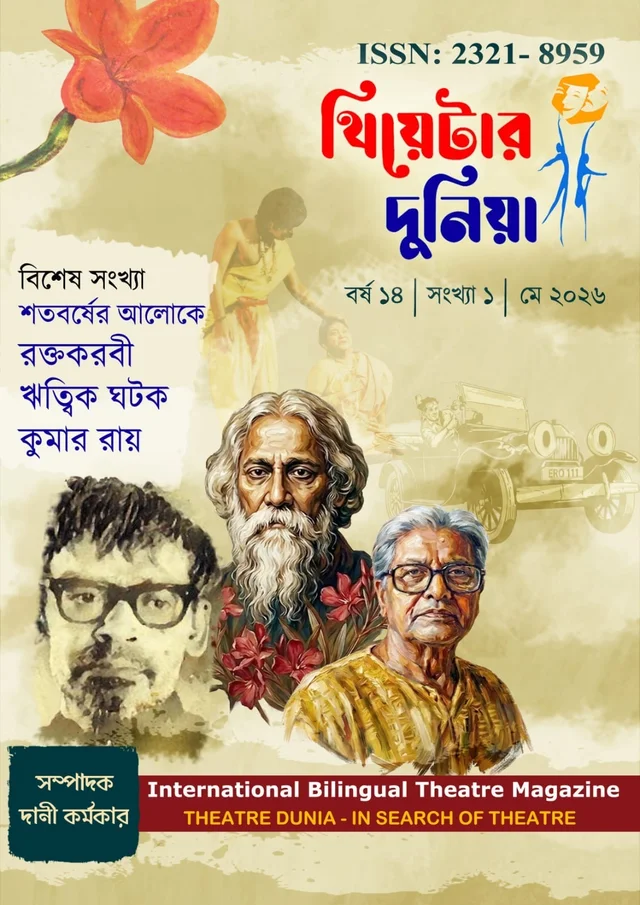
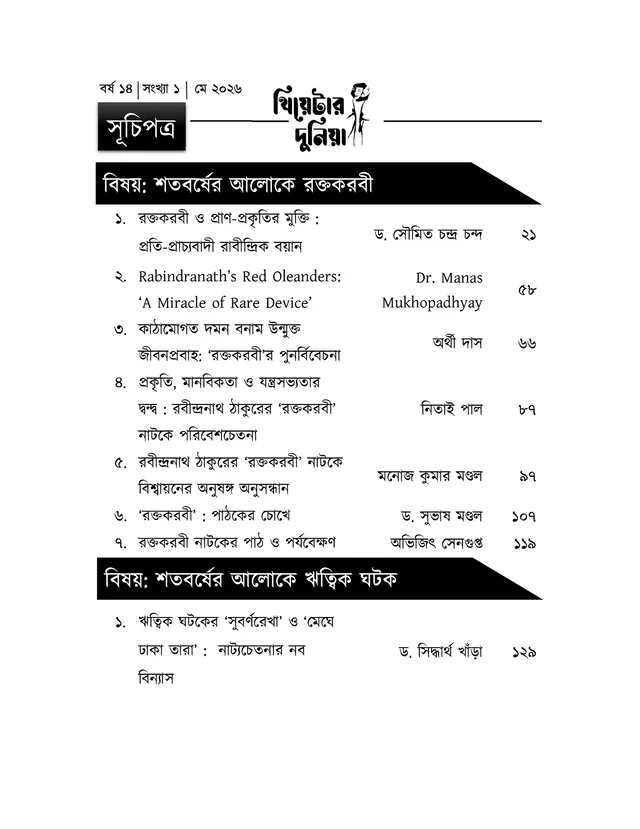
Standing at a crossroads in the context of Bengali culture and theatrical thought, this special issue of Theatre Dunia is being published. In the annals of history, when a creative work or its creator reaches the hundred-year milestone, it does not remain merely an occasion for celebration; it transforms into a unique opportunity for introspection and re-evaluation. We have curated this issue as a tribute on the occasion of the centenary of the publication of Raktakarabi (Red Oleanders)—the timeless allegorical-symbolic play by the lodestar of Bengali literature, Rabindranath Tagore (1861-1941)—and simultaneously, the birth centenaries of two unforgettable pioneers of Bengali art and culture, Ritwik Kumar Ghatak (1925-1976) and Kumar Roy (1926-2010).
After being serialized in the Prabasi magazine in 1924, when Raktakarabi was published as a book in 1926, it did not remain just a play; it became an infallible manifesto for liberating humanity and nature from the predatory clutches of a machine-driven civilization. The renowned 20th-century American theorist, historian, sociologist, and philosopher of technology Lewis Mumford (1895–1990) unveiled a dark side of civilization in his epoch-making book, The Myth of the Machine: Technics and Human Development (1967). Stepping beyond the conventional boundaries of the 'machine', he highlighted the existence of a different kind of 'social machine', which he named the 'Megamachine'. Mumford divided this megamachine into two poles: on one side are colossal construction works (such as pyramids or dams); and on the other, organized destruction (warfare). During the reign of the Third Dynasty of Ur, kings claimed to be divine entities and ordered the construction of massive architecture. Mumford termed this phenomenon the 'colossal labor machine'. The king had acquired such power that he could use humans merely as 'mechanical objects'. The mechanical efficiency used in the construction of pyramids was later utilized to destroy cities or carry out genocides. Mumford's most crucial warning is that the ancient 'megamachine' has reared its head again in the modern era.
Just as ancient kings once declared the 'absolute truth', modern autocratic rulers operate in exactly the same manner. What Mumford referred to as The Myth of the Machine is essentially a blind faith cherished by humanity. People gradually began to harbor the notion that this massive mechanical or organizational structure is 'irresistible' and is dedicated solely to human welfare. Long before Mumford—echoing his theoretical warning about the dominance of the 'megamachine' or super-machine—Rabindranath, through the metaphor of 'Yakshapuri' in his play Raktakarabi, revealed the true nature of a civilization that ultimately descends into mechanical slavery. Even after a century has passed, the exploitation of miners, the insatiable greed for hoarding gold, and the loneliness of a king trapped in his own web—all of these bear profound relevance in the context of today's corporate-controlled and data-driven civilization.
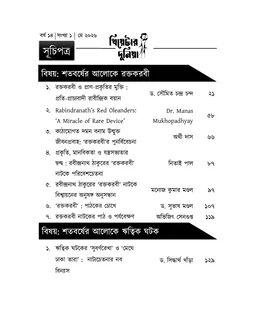
In various essays published in this issue, researchers have shown how Nandini's vermilion-hued call—embodied in the symbol of the Raktakarabi flower—continues to resonate in the hearts of the exploited masses today, serving as a language of resistance. They have also highlighted how Raktakarabi continues to uphold a philosophy that vocally advocates for the liberation of both life and nature; alongside this, they have unraveled the depth of the play's political significance in a post-colonial context.
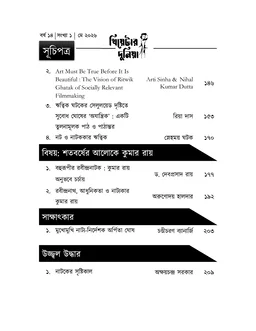
Alongside this, the current issue is illuminated by the brilliance of two personalities whose birth centenaries are being celebrated. Ritwik Kumar Ghatak—a name that usually evokes cinematic imagery in our minds—yet, how much do we truly know of Ritwik as a playwright and actor? From staging Rabindranath's Paritran or Raja during the turbulent days in Rajshahi, to acting in Bisarjan or Voter Bhet for the Indian People's Theatre Association (IPTA)—Ritwik proved time and again that to him, art was not merely a medium of entertainment; it was the voice of the oppressed masses. He himself declared theatre as the best medium to reach millions of people. A deep and detailed analysis of this has been presented, revealing how the post-1947 refugee experience, the clash of political ideologies, and the dark alleys of society enriched Ritwik's theatrical vision—opening up a new horizon for contemporary readers. He brought the scars of contemporary history directly onto the stage. His play Dalil (1952) stands as an epic testament to the agony and struggle for survival of displaced people. The cultural and humanitarian catastrophe that befell Bengalis as a consequence of the Partition is vividly reflected in his plays. His first original play Jwala (1950) was written against the backdrop of the suicide epidemic that spread across Kolkata in the 1950s. This play was a harsh and 'documentary-style' portrayal—showing how unemployment and poverty could push people to the brink of death.
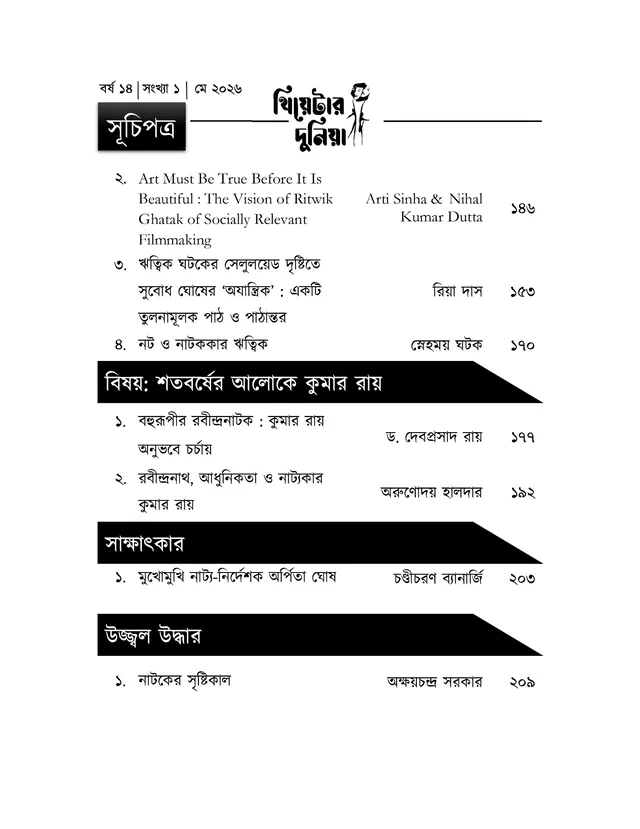
On the other hand, there is Kumar Roy—a personality whose childhood and adolescence were largely spent in the company of Ritwik Ghatak. His journey—which began in 1948 when, accompanied by Ritwik Ghatak, he became a disciple of Sombhu Mitra (1915-1997); and which continued for the next thirty-one years as an inseparable part of the Bohurupee theatre group—gifted the Bengali theatre world a modern and refined aesthetic. He was an extraordinary architect of Sombhu Mitra's 'new theatrical language'—a language where deep, thoughtful immersion took precedence over acting exaggerations. From those early days to the stage of Bohurupee in Kolkata, their expansive collaborative journey remains a golden chapter in the history of Bengali theatre.
Kumar Roy was not merely an actor; he was simultaneously a director, organizer, teacher, and theorist. Shouldering the immense responsibility of Bohurupee in the post-Sombhu Mitra era, he proved that true legacy lies not in a name, but in ideals. Under his direction—from Rabindranath's plays to the adaptation of modern dramas—various theatrical productions attained a distinct and novel dimension. Whether as a professor in the drama department of Rabindra Bharati University or as the editor of Bohurupee—his administrative and theoretical wisdom was unquestionable. In this issue, Kumar Roy's directorial style, his acting method, and his tireless contributions to the Bengali group theatre movement have been remembered with deep respect.
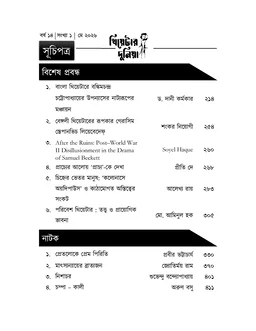
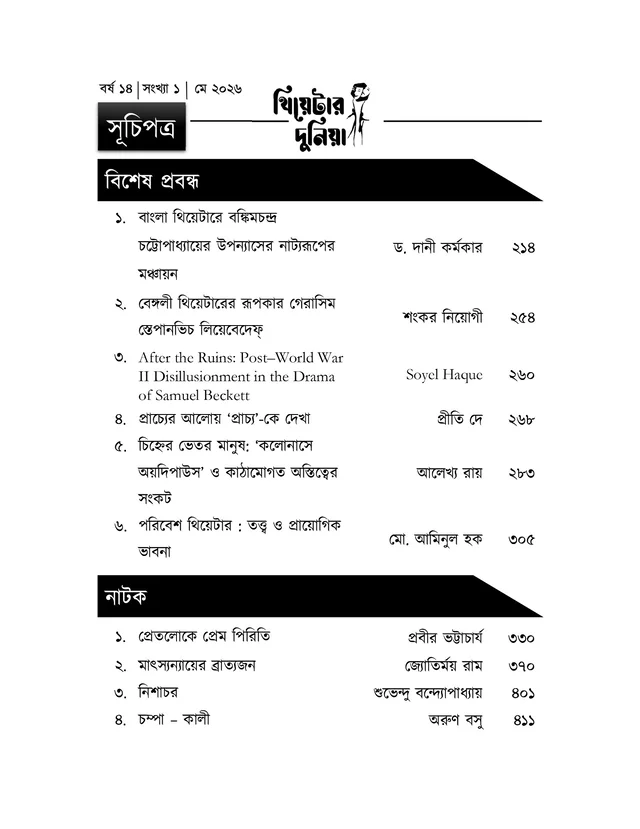
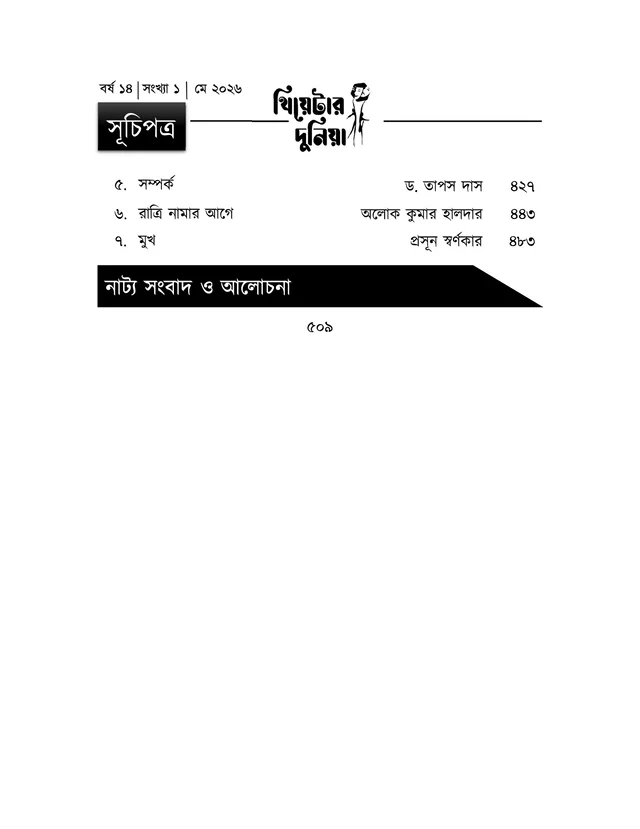
This special issue does not merely celebrate that trio; it also includes several other significant research-based essays. From the staging of theatrical adaptations of Bankim Chandra Chattopadhyay's (1838-1894) works to the relevance of modern environmental theatre—the insightful perspectives presented by various essayists have immensely enriched this compilation. The republication of Akshay Chandra Sarkar's essay, Nataker Srishtikal (The Genesis of Drama), can be considered one of the finest ornaments of this issue. Published 138 years ago—in the Bengali year 1294—in the Nabajiban magazine, this essay remains equally relevant today in analyzing the origins of drama and the nature of social conflict. The pages of this issue also describe the historic theatrical endeavors of Gerasim Stepanovich Lebedev (1749-1817)—a pioneer in shaping the Bengali theatrical tradition.
Viewed from the perspective of global theatre theory, this issue specifically highlights a theoretical analysis of Samuel Beckett's (1906-1989) plays—where post-World War II disillusionment and the core principles of 'Absurd Theatre' are discussed, with the crisis of language and existence emerging as the focal point. Additionally, it features a discussion on the Bangladeshi playwright Selim Al Deen's (1949-2008) play Prachya—the creation of a writer deeply rooted in his own cultural heritage. Overcoming the sense of 'cultural rootlessness' characteristic of the nineteenth century, the investigative discussion on how Selim Al Deen built an independent stream of modern Bengali drama based on indigenous aesthetics has opened a new horizon in the world of research. Through the essayist's insightful writing, Sophocles' (c. 496–406 BCE) play Oedipus at Colonus has been re-evaluated from both Marxist and structuralist perspectives, presenting it as a profound document on the dynamics of power and social structure. Alongside these discussions, there is an exploration of the theory and application of 'Environmental Theatre'—a concept that transcends the boundaries of the traditional proscenium stage, adding a new dimension to the spatial dynamics and audience engagement of 'Third Theatre' or street plays. Furthermore, this issue is enriched by the inclusion of several original and research-based plays, which deeply resonate with the sensibilities of the contemporary era.
As an editor, I firmly believe that the essays in this special issue—which are not mere reminiscences—will provide new sustenance to the evolution and research of Bengali theatre. I express my humble gratitude to the readers, researchers, and well-wishers whose genuine love has enabled Theatre Dunia to step into its fourteenth year today. It is my sincere hope that this centennial beacon will further illuminate our future path of theatrical research and stage practice.
- Premium Quality
- Handcrafted Products
- Secure Checkout
- Easy Returns & Refunds
- Pan India Delivery
- Made in India
Delivery Options
Get delivery at your doorstep
Features
| Author/Editor | Editor: Dani Karmakar |
| Binding | Paperback |
| Language | Bilingual |
| Pages | 518 |
| Product Weight | 0.68 Kg |
| Publication Date | May, 2026 |
| RNI/ISSN | ISSN: 2321-8959 |
Theatre Dunia - May 2026 Issue (Vol. 14, Issue. 1)
ISSN: 2321–8959
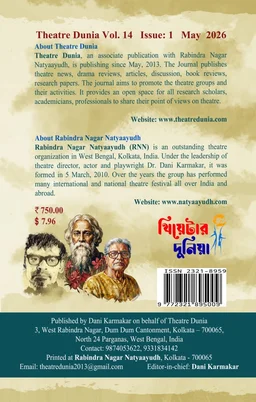
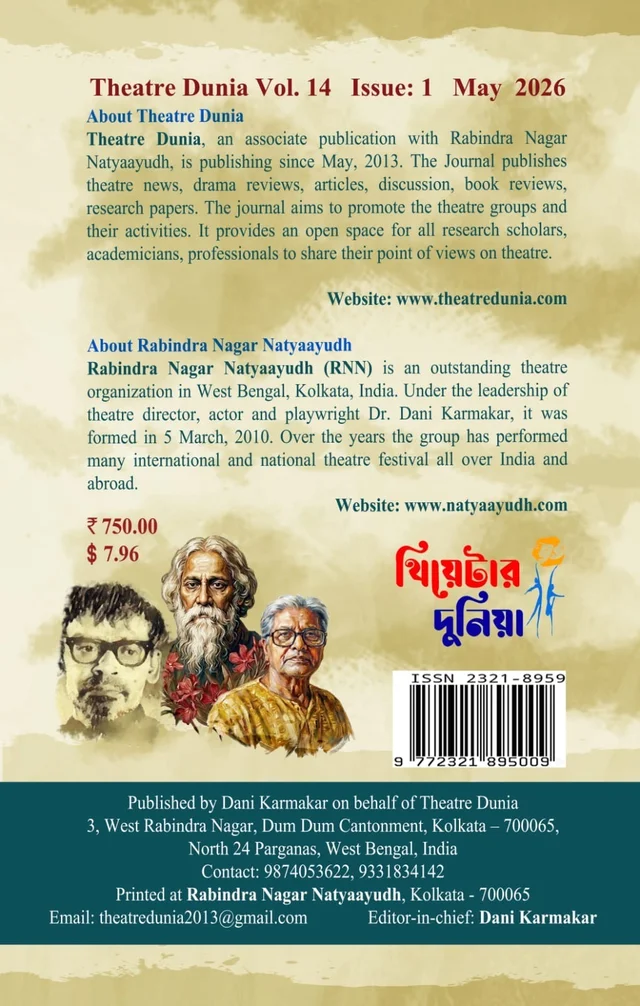
Theatre Dunia, the renowned International Bilingual Theatre Magazine, unveils its latest masterpiece – a collector’s edition that celebrates the vibrant legacy of Indian theatre with scholarly depth and artistic finesse. Featuring a serene light-blue cover adorned with expressive visual elements, this issue is a tribute to the cultural richness and aesthetic depth of theatre as a transformative art form.
Special Issue: Honoring Icons and Legacies
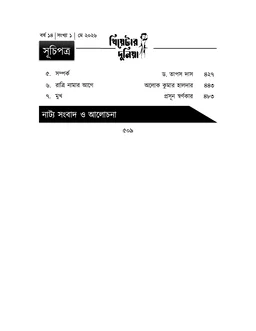
In this commemorative edition, Theatre Dunia marks a pivotal moment in theatre history with a special focus on “In the Light of the Birth Centenary: Raktakarabi, Playwright Ritwik Ghatak, and Playwright Kumar Roy.” This thoughtful exploration honors the timeless contributions of these luminaries to Indian theatre, offering a blend of historical perspectives and contemporary reflections.
Edited by the Visionary Dani Karmakar
Under the expert guidance of Dani Karmakar, this issue becomes a treasured resource for theatre practitioners, researchers, and enthusiasts. His editorial vision has carefully curated an archive that bridges the past and present, making this volume a must-have for anyone passionate about theatre’s evolving narrative.
Guided by the Motto: “THEATRE DUNIA – IN SEARCH OF THEATRE”
Theatre Dunia continues its mission to explore theatre as a form of art, ideology, and social discourse. This issue delves into the interplay between traditional roots and modern interpretations, creating a dialogue that resonates with theatre lovers worldwide.
Why You’ll Love This Issue
- Insightful Content: Discover in-depth articles and essays that celebrate Indian theatre legends Ritwik Ghatak and Kumar Roy, alongside an analysis of Tagore’s iconic play Raktakarabi.
- Expert Curation: Edited by Dani Karmakar, ensuring the highest standards of scholarship and creativity.
- Collector’s Edition: Perfect for researchers, students, and collectors who value the preservation of theatre history.
- Bilingual Excellence: Presented in both English and Bengali, catering to diverse audiences.
Perfect For
- Theatre enthusiasts seeking unparalleled insights into Indian theatre.
- Researchers and scholars exploring the intersection of culture, art, and history.
- Collectors eager to own a timeless archive of theatrical brilliance.
Don’t miss your chance to own this exclusive issue of Theatre Dunia, brought to you by Bharat Sanskriti Bazaar™. Whether you’re a passionate theatre lover, an academic, or a cultural aficionado, this volume promises to inspire and enlighten.
Order Now
Immerse yourself in the world of Indian theatre with Theatre Dunia - Vol. 14, Issue 1. Add this collector’s edition to your library today and be part of the ongoing journey “In Search of Theatre.”
Get your copy now at Bharat Sanskriti Bazaar™ and celebrate the legacy of Indian theatre!
Reviews and Ratings
No reviews yet